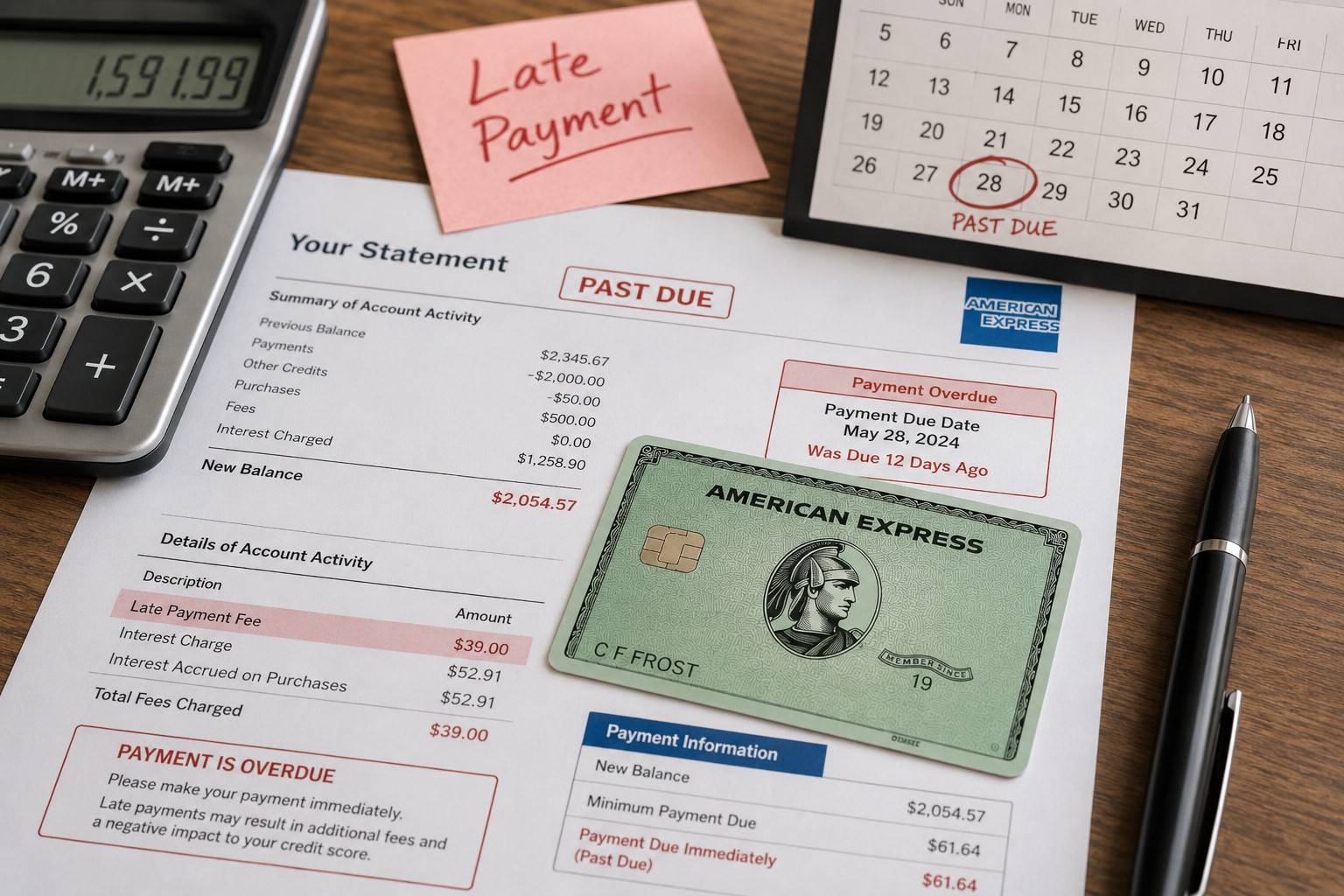




You received your credit card statement, paid the minimum amount by the due date, and then paid the rest of the statement balance only a few days later.
From your perspective, the statement is now fully paid. So why does the next statement still include an interest charge?
This situation can feel confusing, especially when the payment was only two or three days late. The answer is that paying the minimum on time and paying the full statement balance on time accomplish two different things.
Paying the minimum prevents the account from becoming past due. Paying the full statement balance by the due date is generally what preserves the card’s interest-free treatment.
When the full statement balance is paid after the due date—even just a few days later—the payment does not erase the interest that has already accumulated.
Let’s break down exactly how this works.
Paying the minimum is not the same as paying the statement balance
Your credit card statement may show several different amounts:
- Minimum Payment Due
- Statement Balance
- Current Balance
- Pay Over Time Balance
- Account Total New Balance
These amounts serve different purposes.
The minimum payment is the smallest required payment you must make by the due date to keep the account current and avoid a late-payment fee.
The statement balance is the amount that appeared on the account when the billing period closed.
When you pay only the minimum, your payment is considered on time. However, the remaining statement balance is carried into the next billing period and may become subject to interest.
In other words:
Paying the minimum helps you avoid being late, but it does not necessarily help you avoid interest.
To maintain the interest-free treatment on eligible Pay Over Time purchases, the full required statement balance generally must be paid by the due date.
A practical example
Consider the following situation:
- Previous statement balance: $0
- Purchase date: July 10
- Purchase amount: $1,000
- Billing period: July 1 to July 31
- Statement closing date: July 31
- Statement balance: $1,000
- Minimum payment due: $100
- Payment due date: August 25
- Minimum payment made on August 25: $100
- Remaining payment made on August 28: $900
The cardmember eventually paid the full $1,000 statement balance.
However, the entire statement balance was not paid by the August 25 due date. Only the $100 minimum payment was paid by then.
That difference explains why interest can still appear.
Was the cardmember late?
No—not in the normal late-payment sense.
The required $100 minimum payment was received by August 25. Therefore, assuming the payment was credited properly and there were no other required amounts, the account was not past due.
The cardmember would generally avoid:
- A late-payment fee
- A missed minimum payment
- The consequences specifically associated with failing to make the required payment
But the cardmember did not pay the entire $1,000 statement balance by August 25.
That means the account may lose its interest waiver for the following billing period.
Why the July billing period may remain interest-free
The $1,000 purchase was made on July 10, during the July 1–31 billing period.
According to the agreement used for this example, American Express does not charge interest on automatically added Pay Over Time purchases during a billing period when:
- The Pay Over Time Previous Balance was zero;
- The account was not past due; and
- The required Amount Due or Minimum Payment Due was paid by the due date.
In this example, the previous Pay Over Time balance was zero, and the $100 minimum was paid by August 25.
Therefore, the July billing period may qualify for the interest waiver.
That means the cardmember normally would not be charged interest for:
July 10 through July 31
The failure to pay the entire balance by August 25 does not necessarily cause American Express to go back and charge interest for the July period.
Instead, the problem begins with the next billing period.
The next billing period begins before the payment due date
This is the part that causes the most confusion.
The July statement closed on July 31, but its payment was not due until August 25.
Meanwhile, a new billing period began on August 1.
Therefore, the following two periods overlap:
- The July statement is waiting to be paid.
- The August billing cycle is already underway.
Many cardmembers assume that interest cannot begin until after August 25. But under this agreement, interest is determined separately for each billing period.
The August billing period has a Pay Over Time Previous Balance of $1,000 because that was the unpaid balance carried over from July 31.
To receive the interest waiver for August, the cardmember would generally need to satisfy the agreement’s waiver rules. Because the full July statement balance was not paid by August 25, the August billing period does not qualify for the waiver in this example.
As a result, the August billing cycle becomes interest-bearing.
Which dates are covered by interest?
Assuming the billing period is August 1 through August 31, the interest calculation would generally follow this timeline.
| Dates | Approximate unpaid principal | What happens |
|---|---|---|
| July 10–July 31 | $1,000 | July period may remain interest-free |
| August 1–August 24 | $1,000 | Interest accrues daily |
| August 25 | $900 after the $100 payment | Interest is based on the reduced daily balance |
| August 26–August 27 | $900 | Interest continues daily |
| August 28 | $0 of purchase principal after the $900 payment | The original purchase principal is paid |
| August 29–August 31 | Accumulated interest may remain | A small amount of additional interest may accrue |
The key point is that interest does not begin only on August 26, the day after the payment due date.
Because the August billing period did not qualify for the interest waiver, interest can be calculated beginning on August 1.
Is interest charged on the full $1,000 for the entire month?
No.
Interest is calculated according to the balance owed on each day.
For this example:
- From August 1 through August 24, approximately $1,000 remains unpaid.
- When the $100 payment is credited on August 25, the balance drops to approximately $900.
- From August 25 through August 27, interest is based on approximately $900.
- When the $900 payment is credited on August 28, the original purchase principal is paid.
Therefore, the cardmember is not charged interest on $1,000 for all 31 days.
The payment reduces the balance used for the interest calculation on the date the payment is credited.
A payment made after the issuer’s daily cutoff time, however, may not receive credit until the following day. That could result in one additional day of interest.
Why doesn’t the $900 payment on August 28 clear everything?
Because by August 28, the cardmember owes more than just the remaining $900 purchase balance.
Interest has already been accumulating since August 1.
For example, the account may contain:
- Remaining purchase balance: $900
- Accrued but not yet billed interest: approximately $14
- Actual amount needed to completely clear the account: approximately $914
If the cardmember pays exactly $900, the remaining purchase principal is covered. But the unbilled interest is not.
That interest normally appears when the next statement closes.
This is why the account may show a new balance even though the cardmember believes the previous statement was paid completely.
An approximate interest calculation
Suppose the applicable APR is 20%.
The approximate daily rate would be:
20% ÷ 365 = approximately 0.0548% per day
For August 1 through August 24:
$1,000 × 20% ÷ 365 × 24 days = approximately $13.15
For August 25 through August 27:
$900 × 20% ÷ 365 × 3 days = approximately $1.48
Before accounting for daily compounding, the estimated interest would be:
$13.15 + $1.48 = approximately $14.63
The actual amount may be slightly different because American Express uses an Average Daily Balance calculation and compounds interest daily. The exact APR, posting dates, payment-credit dates, rounding rules, new purchases, fees, and credits can also affect the result.
When will the interest appear?
The next billing cycle runs approximately:
August 1 through August 31
The statement for that cycle closes around August 31.
That statement may show:
- The $100 payment made on August 25
- The $900 payment made on August 28
- Any new purchases made during August
- Interest calculated during the August billing period
- Any remaining balance
If the normal payment schedule continues, that August statement would likely be due around September 25.
Therefore, even though the purchase principal was paid by August 28, the interest calculated during August may not appear until the statement closes on August 31.
What is trailing or residual interest?
Trailing interest—also called residual interest—is interest that accumulates after a statement closes but before the balance is actually paid.
For example, suppose a statement already contains an interest-bearing balance. That statement closes on August 31, but the cardmember waits until September 25 to pay it.
Interest may continue accruing between:
September 1 and September 24
That additional interest could then appear on the statement that closes at the end of September.
This creates a frustrating situation:
- You pay the balance shown on the statement.
- Another small interest charge appears on the next statement.
- You wonder why the account was not completely cleared.
The reason is that the statement only included interest calculated through its closing date. It could not include interest for the days that occurred after the statement was generated.
Can interest continue after the $900 payment?
The $900 purchase principal should stop accruing interest once the payment is properly credited on August 28.
However, the interest accumulated from August 1 through August 27 may remain unpaid.
Because the agreement uses daily compounding, the accumulated interest may itself become part of the daily balance. That means a very small additional amount may accrue between August 28 and the August 31 statement closing date.
This is usually much smaller than the interest charged on the original $1,000 balance, but it helps explain why the final amount may be slightly higher than a simple calculation suggests.
What happens to new purchases?
Once the account loses its interest waiver, new eligible Pay Over Time purchases may also begin accruing interest from their transaction dates.
Suppose the cardmember makes another $200 purchase on August 15.
Because the August billing cycle is already interest-bearing, that new $200 charge may begin accumulating interest starting on August 15. The cardmember may not receive the normal interest-free period for that purchase.
This is one reason it can be helpful to temporarily stop using the card while paying off an interest-bearing balance.
Continuing to make new purchases can make it harder to determine:
- Which balance is being paid
- Which purchases are accruing interest
- How much is needed to restore the interest-free period
- Whether residual interest remains
How can the cardmember stop the interest?
Paying the remaining purchase balance is an important first step, but it may not clear the account completely.
A practical approach is to:
- Stop making new purchases temporarily.
- Pay the outstanding balance as soon as possible.
- Wait for any pending interest to post.
- Pay the new statement balance in full by its due date.
- Check the following statement for any final residual interest.
The cardmember may also contact American Express and ask for the amount required to pay the interest-bearing balance completely through a specific date.
This may be called a payoff amount or a payoff balance, although the exact terminology can vary.
How do you restore the interest-free period?
Under the agreement used for this example, one way to qualify for the interest waiver is to have paid the full Account Total New Balance—or the applicable Adjusted Balance—for each of the previous two billing periods by their due dates.
Therefore, after carrying a balance, the cardmember may need to pay statement balances in full and on time for consecutive billing periods before normal interest-free treatment is fully restored.
The exact timing depends on:
- Whether the Pay Over Time Previous Balance is zero
- Whether any residual interest remains
- Whether new purchases were made
- Whether the full required balances were paid by their due dates
- Whether the account contains Plan It, Pay Over Time Select, cash-advance, or other balances
Because account situations differ, the cardmember should check the “Interest Charge Calculation” section of each statement or contact American Express for the account-specific grace-period status.

Does paying a few days after the due date cause a late fee?
It depends on whether the minimum payment was made on time.
In this example, the $100 minimum payment was received on August 25. Therefore, the cardmember was not late on the required minimum payment.
The $900 payment made on August 28 was late only in the sense that it arrived too late to preserve the interest waiver. It does not necessarily mean the account was past due or that a late fee applies.
This distinction is important:
Minimum paid on time, full balance paid late
Possible consequences:
- No late-payment fee
- Account remains current
- Interest is charged
- Interest-free treatment may be lost
Minimum not paid by the due date
Possible consequences:
- Late-payment fee
- Account becomes past due
- Interest continues
- Possible penalty APR
- Other account consequences
Statement balance versus current balance
Another common source of confusion is the difference between the statement balance and the current balance.
The statement balance is a snapshot taken on the statement closing date.
The current balance can include activity occurring after the statement closed, such as:
- New purchases
- Payments
- Credits
- Fees
- Posted interest
- Pending or recently posted transactions
Paying the old statement balance after the due date may not equal paying the entire current balance.
In the example, paying $100 plus $900 covers the original $1,000 statement balance. But it does not automatically cover the interest that accumulated during August.
That is why the account can still have money owed.
The most important lesson
A credit card due date serves two separate purposes.
First, it is the deadline for making the required minimum payment and avoiding a late-payment fee.
Second, it is generally the deadline for paying the full statement balance and preserving interest-free treatment.
Paying only the minimum by the due date satisfies the first requirement, but not necessarily the second.
In the example:
- The cardmember paid the minimum on August 25, so the account remained current.
- The remaining $900 was not paid until August 28.
- The August billing cycle did not qualify for the interest waiver.
- Interest accumulated on the daily unpaid balances beginning August 1.
- Paying $900 covered the remaining purchase principal but not the interest already accumulated.
- That interest appeared—or would likely appear—on the statement closing around August 31.
Final takeaway
Seeing interest after paying the full statement balance can be surprising, but it does not necessarily mean the credit card company ignored the payment.
The issue is timing.
The statement balance was ultimately paid, but it was not paid in full by the due date. As a result, the account lost its interest-free treatment for the following billing period, and interest accumulated before the final payment was received.
The easiest rule to remember is:
Paying the minimum by the due date helps you avoid a late fee. Paying the full statement balance by the due date generally helps you avoid interest.
And once an account has started accruing interest, paying the amount printed on an older statement may not be enough. You may also need to pay the interest that accumulated after that statement closed.